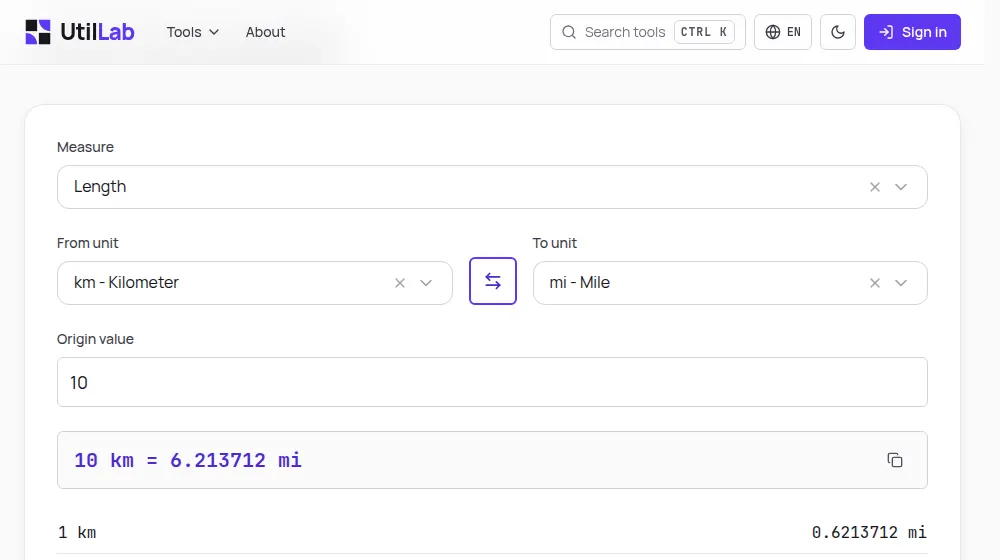
How to convert a value
- Open the Measure list and choose what you are measuring. The list is searchable: type “temp” or “press” to filter it. The page opens on length, converting 1 centimetre to inches.
- Choose the From unit and the To unit. Each entry shows the symbol and the name, for example
ft-us - US Survey Foot, which helps when two units have similar names. - Type the number in the Origin value field. A comma or a point both work as the decimal separator:
1,5and1.5are read the same way, and1 234,56or1,234.56are understood too. Thousands separators work as well:1,000and10,000mean thousands. One catch: a single separator followed by exactly three digits counts as a thousands separator, so2.125is read as 2125; type2.1250when you mean two and an eighth. - Read the result line, such as
12 in = 30.48 cm. The copy button next to it copies the whole line, units included. - To convert in the opposite direction, press the arrows button between the two unit lists: it swaps the units and keeps your value.
Under the result, a table converts 1, 2, 5, 10, 20, 50, 100 and 1,000 of the source unit at once. It is a quick way to print a small chart for the kitchen or the workshop, or to check several quantities from the same recipe without retyping. The page address keeps your choices, so a bookmarked or shared link reopens on the same conversion.
What you can convert
The converter covers 23 measures, and a conversion is always between two units of the same measure. Turning litres into kilograms or cups of flour into grams is not a unit conversion but a density problem, so those pairs are not offered.
- Everyday measures: length, area, mass, volume, temperature, time, speed and count (units and dozens).
- Computing: digital storage from single bits to terabytes, in bits and in bytes.
- Running and cycling: pace in minutes per kilometre, minutes per mile, seconds per metre and seconds per foot.
- Science and engineering: pressure (pascal, bar, torr, psi), energy (joule, watt-hour), power, electric current, voltage, frequency (including rpm and radians per second), angle, illuminance (lux, foot-candle), volumetric flow rate and parts per million, billion, trillion and quadrillion.
- Power systems: reactive power (VAR), apparent power (VA) and reactive energy (VARh), with their kilo, mega and giga multiples.
How the result is calculated
The calculations come from the open-source convert-units library. Every unit is defined as a multiple of a base unit of its system, the metre on the metric side and the foot on the imperial side for length, and the two systems are tied by a fixed ratio. Your value is multiplied up to the base unit, carried across to the other system when needed and divided down to the target unit. Temperature is the exception, because its scales do not share a zero: Celsius to Fahrenheit needs a multiplication and an offset.
result = value × factor(from unit) ÷ factor(to unit) °F = °C × 9/5 + 32Example 1, length: an inch is defined as 2.54 cm, so 12 in = 12 × 2.54 = 30.48 cm, and 180 cm ÷ 2.54 = 70.86614 in.
Example 2, temperature: 180 °C × 9/5 + 32 = 356 °F, a common oven setting. In the other direction, 0 °F = (0 − 32) × 5/9 = −17.77778 °C. The two scales meet at −40, where −40 °C is also −40 °F.
Example 3, data: a byte has 8 bits, so a download speed of 100 Mb/s moves at most 100 ÷ 8 = 12.5 MB per second. That is why a 100-megabit connection never shows “100” in a download window.
Rounding and how results are displayed
Each result is rounded to 7 significant digits. This is what turns the library's internal 2.5399999187 back into the exact 2.54 cm per inch, and it is more precision than any household or workshop instrument can use. The display then shows at most seven decimal places, so very small results lose digits on screen: 1 mm shows as 0.0393701 in.
Results below 0.000000001 or from 1,000,000,000,000,000 upward switch to scientific notation, for example 1 nanosecond = 3.1688e-17 years. Large whole numbers also lose their last digits: 500 GB converted to bytes shows 536,870,900,000, while the exact value is 536,870,912,000 (500 × 1,024³). When you need an exact count of bytes, multiply it out yourself.
Units that are easy to confuse
- KB, MB, GB use steps of 1,024. Here 1 GB = 1,024 MB. Drive makers count in steps of 1,000, so a drive sold as 500 GB holds 500,000,000,000 bytes, which converts to 465.6613 GB, the figure Windows shows for such a drive.
- Bits and bytes. A lowercase b is a bit and an uppercase B a byte: 1 MB = 8 Mb. Internet plans are sold in megabits, files are measured in megabytes.
- US volumes only. Gallon, quart, pint, cup and fluid ounce are US customary: 1 gal = 3.785412 L. The imperial gallon (4.54609 L) is not in the list.
- Two kinds of ton.
tis the US short ton of 2,000 lb (907.184 kg);mtis the metric tonne of 1,000 kg. - Tablespoons differ by country. The US tablespoon (
Tbs) is 14.78676 ml; the Swedishmskin the same list is exactly 15 ml. The list also holds the other Swedish kitchen measures: krm (1 ml), tsk (5 ml), kkp (150 ml), glas (200 ml) and kanna (2.617 L). - m/h means miles per hour, not metres per hour: 120 km/h = 74.56454 m/h.
- Foot and US survey foot differ by two parts per million (1 ft-us = 1.000002 ft). Only land surveyors working over long distances need the survey foot.
When to double-check the number
The library stores the pound as 0.453592 kg instead of the legal definition of 0.45359237 kg, so pound and ounce results can be off in the seventh digit: 70 kg shows as 154.3237 lb, while the exact definition gives 154.3236 lb. The knot is in the same situation and shows 1.851999 km/h instead of exactly 1.852. That makes no difference to a recipe, a parcel or a boat trip, but for laboratory, legal or trade measurements, use the official definitions.
The converter does not judge whether a value makes physical sense. It will turn −300 °C into −26.85 K even though nothing can be colder than 0 K. Pace results are decimal minutes rather than minutes and seconds: 5 min/km converts to 8.046746 min/mi, which is about 8 minutes 3 seconds per mile (0.046746 × 60 ≈ 2.8 s). Months and years are averages of 30.4375 and 365.25 days, which suits estimates but not calendar counting.