What the age calculator tells you
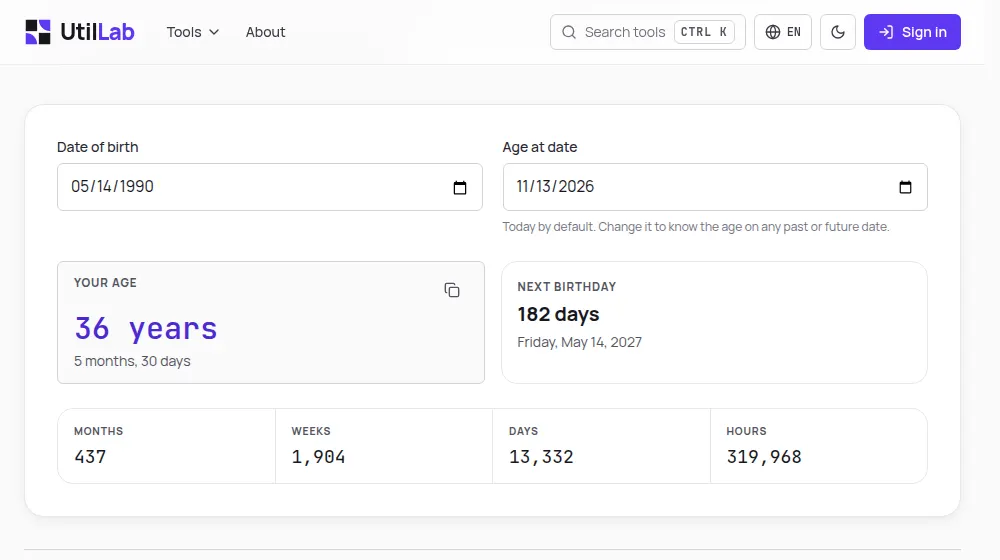
Give it a date of birth and the calculator answers the question "How old am I?" precisely: the age in completed years, plus the months and days since the last birthday. It also shows the same age as totals in months, weeks, days and hours, and a card with the date of the next birthday, its weekday and how many days are left.
Age is not the same thing as the plain distance between two dates. It counts birthdays, which is why it moves up on one particular day each year and why 29 February needs special handling. For the number of days between any two dates, Days Between Dates is the simpler tool; for a date that lies a set time before or after today, use the Date Calculator.
How to calculate your age
- Enter the Date of birth. The date picker does not offer days after today.
- Leave Age at date on today, or change it to any other date to get the age on that day.
- Read Your age: the large number is the completed years, and the line below gives the extra months and days.
- Check the Next birthday card and the totals row underneath. The copy button copies the age as a line such as "36 years, 5 months, 27 days".
If the date of birth is later than the reference date, a message asks you to correct one of them instead of showing a negative age.
How exact age is calculated
The calculator first finds the most recent birthday on or before the reference date; the number of birthdays passed is the age in years. From that birthday it counts whole months, each running from a day of the month to the same day of the next month, and then the days that remain. The examples below were checked with the same functions the page uses.
- Born 15 May 1990, on 11 November 2026: 36 years, 5 months and 27 days. The last birthday was 15 May 2026, five whole months bring it to 15 October, and 27 days more reach 11 November.
- Born 31 January 2000, on 1 March 2026: 26 years, 1 month and 1 day. February 2026 has no 31st, so the month counted from 31 January ends on 28 February, and one day remains.
- Born 10 March 2008: on 9 March 2026 the age is 17 years, 11 months and 27 days, with 1 day to the next birthday. On 10 March 2026 it is exactly 18 years and the card reads "Today! Happy birthday".
Totals in months, weeks, days and hours
The totals row restates the same age in single units. Months is the completed years times 12 plus the extra months. Days are counted one by one between the two dates, so every 29 February in between is included, and Weeks are the whole weeks in that number of days. Hours are the days multiplied by 24.
For the person born on 15 May 1990, on 11 November 2026 that gives 437 months, 1,904 weeks, 13,329 days and 319,896 hours. Multiplying 36 years by 365 would give only 13,140 days, because it ignores the nine leap days from 1992 to 2024 and the months since the last birthday. Since no time of birth is asked for, the hours are counted from midnight to midnight.
Birthdays on 29 February
People born on a leap day have a real birthday only once every four years. In the years in between, the calculator counts the birthday on 28 February: the countdown on the next-birthday card reaches zero that day and the completed years go up by one. On 27 February 2027 a person born on 29 February 2000 reads 26 years, 11 months and 30 days; on 28 February 2027, 27 years exactly; on 1 March 2027, 27 years and 1 day. In 2028 the birthday falls on 29 February again.
Laws do not all agree on this point, and some set the legal birthday of leap-day births on 1 March in common years. When an exact legal age matters, such as for a driving licence or a pension, confirm the rule of the country concerned.
Age on another date
The "Age at date" field turns the tool into a planning aid. Set it to the closing date of an application to check an age limit, to the first day of school to see whether a child is old enough, or to a past date to find how old someone was at an event. Someone born on 15 May 1990 will be 39 years, 7 months and 17 days old on 1 January 2030. When the reference date changes, the next-birthday countdown and all the totals follow it.
Things to keep in mind
- International age. The page uses the method where a newborn is 0 and gains a year on each birthday. Traditional counts that start at 1, or that add a year at the new year, give a higher number.
- Time of birth and time zones. The age changes at midnight on the birthday, in the time zone of your device. Someone born late at night in another time zone may see a one-day difference.
- Privacy. The calculation runs in your browser and the tool does not save the date of birth. A link with
?birth=carries the date in the address, so think before sharing it. - Not only people. Any start date works, from a company's founding date to the purchase date of a car.