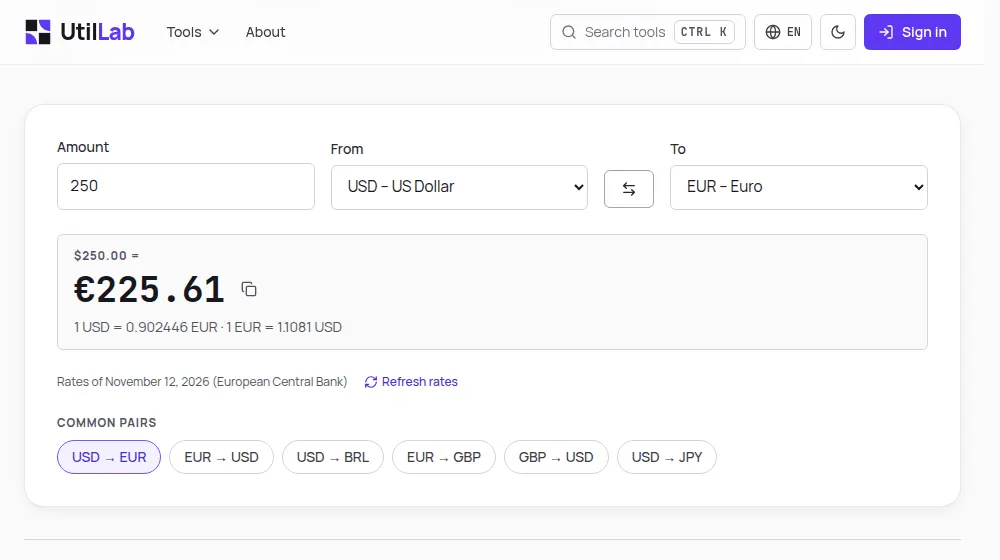
How to use the converter
- Type the Amount. It starts at 100. A comma or a point works as the decimal mark (
12,50or12.50), and thousands separators are understood:2,500and2.500both mean two thousand five hundred, and2,500.75is read as written. - Pick the currency you have in From and the one you want in To. The ten most used currencies are at the top of each list, followed by the rest in alphabetical order of their codes.
- Read the converted amount in the result box. Under it you see the rate in both directions, for example
1 USD = 0.75 GBP · 1 GBP = 1.33333 USD. - Press the arrows button to swap the two currencies, or tap one of the Common pairs chips, such as USD → EUR or USD → JPY, to load it in one go.
- Check the date line below the result. If you want the newest publication, press Refresh rates.
The pair you last used is remembered in this browser, so a regular conversion is ready the next time you open the page.
Where the rates come from
Thirty currencies, the euro included, use the euro reference rates of the European Central Bank. The ECB sets them once per working day, around 16:00 Central European Time, from a regular concertation between central banks, and publishes them for information. They cover the dollar, pound, yen, Swiss franc, yuan, the Canadian and Australian dollars, the Mexican peso, the Brazilian real, the Indian rupee, the Turkish lira and the main currencies of northern and eastern Europe and Asia. We fetch them through Frankfurter, a free service that republishes the ECB data.
The 44 currencies the ECB does not quote come from currency-api, an open dataset of daily market rates. They include most of Latin America (Argentine, Chilean, Colombian and Uruguayan pesos, Peruvian sol, Bolivian boliviano), the Gulf (UAE dirham, Saudi riyal, Qatari riyal, Kuwaiti dinar), Africa (Egyptian pound, Moroccan dirham, Nigerian naira, Kenyan shilling, the CFA francs), Eastern Europe and Central Asia (Russian ruble, Ukrainian hryvnia, Kazakh tenge) and South Asia (Pakistani rupee, Bangladeshi taka). When a pair involves one of them, the date line reads Market rates of … instead of naming the ECB.
How the conversion is calculated
Every rate is stored as the number of units of a currency that one euro buys. A conversion therefore goes through the euro: the amount is divided by the rate of the currency you have and multiplied by the rate of the currency you want. When one side is the euro, its rate is simply 1.
result = amount ÷ rate(From) × rate(To) (rates in units per 1 EUR)The examples below use round sample rates so you can follow the arithmetic; the tool itself always uses the latest published figures.
Example 1: with 1 EUR = 1.16 USD and 1 EUR = 0.87 GBP, 250 USD = 250 ÷ 1.16 × 0.87 = 187.50 GBP. The rate line would read 1 USD = 0.75 GBP and 1 GBP = 1.33333 USD.
Example 2: converting to the euro only needs one division: 100 USD = 100 ÷ 1.16 = 86.21 EUR.
Example 3: with 1 EUR = 1,700 ARS, one Argentine peso is 1 ÷ 1,700 × 1.16 = 0.000682 USD. Because that is under one cent, the result keeps three significant digits instead of showing $0.00. Amounts of 0.01 or more are rounded to two decimals, and the rates are shown with six significant digits.
The reference rate is not the price you pay
A reference rate sits between the buying and selling prices of the market and includes no profit for anyone. Whoever actually changes your money adds a spread, a fixed fee or both. Card payments abroad, international transfers, airport kiosks and cash withdrawals all work this way, and the gap varies a lot from one provider to another.
To see what a transfer really costs, compare the amount the provider promises to deliver with the amount this converter shows for the same sum:
cost (%) = (reference amount − amount received) ÷ reference amount × 100With the sample rate above, 1,000 USD is worth 862.07 EUR at the reference rate. If a service delivers 835.00 EUR, its total cost is 27.07 EUR, or 3.14%, whatever it says about “zero fees”. When a shop terminal or cash machine abroad offers to charge you in your home currency, it is choosing the rate for you; paying in the local currency usually costs less.
When to treat the number with care
- Rates move during the day. The ECB figure is a single snapshot taken in the afternoon in Frankfurt. For a large purchase made hours later, expect a small difference.
- Weekends and holidays. The ECB does not publish on those days, so the last working day's rates stay on screen. Check the date before quoting a figure.
- Currencies with controls or several rates. Where an official rate and a parallel rate coexist, as has happened in Argentina and Venezuela, the market dataset gives one figure that may not match what a bank or exchange office will actually offer you.
- Mixed pairs. A pair such as USD to ARS combines an ECB rate and a market rate, which are published on different schedules and can be a day apart.
- Not for trading. These figures are for budgets, invoices, travel planning and price comparisons. They are not live dealing prices. Cryptocurrencies are not included.
Offline use and caching
The converter asks our server for the rate table and saves a copy in your browser, which it reuses for up to six hours before asking again. If the network is unavailable, it falls back to the last saved table and adds offline: showing saved rates next to its date, so you can still convert in a plane or abroad without data. Nothing you type in the amount field is sent anywhere: the server only provides the table, and the arithmetic happens on your device.